Choosing and Giving
Fresh and Artificial Wreaths Compared
Compare fresh and artificial wreaths on look, scent, cost, storage and reuse, and decide which suits a front door, a gift or a rented home.
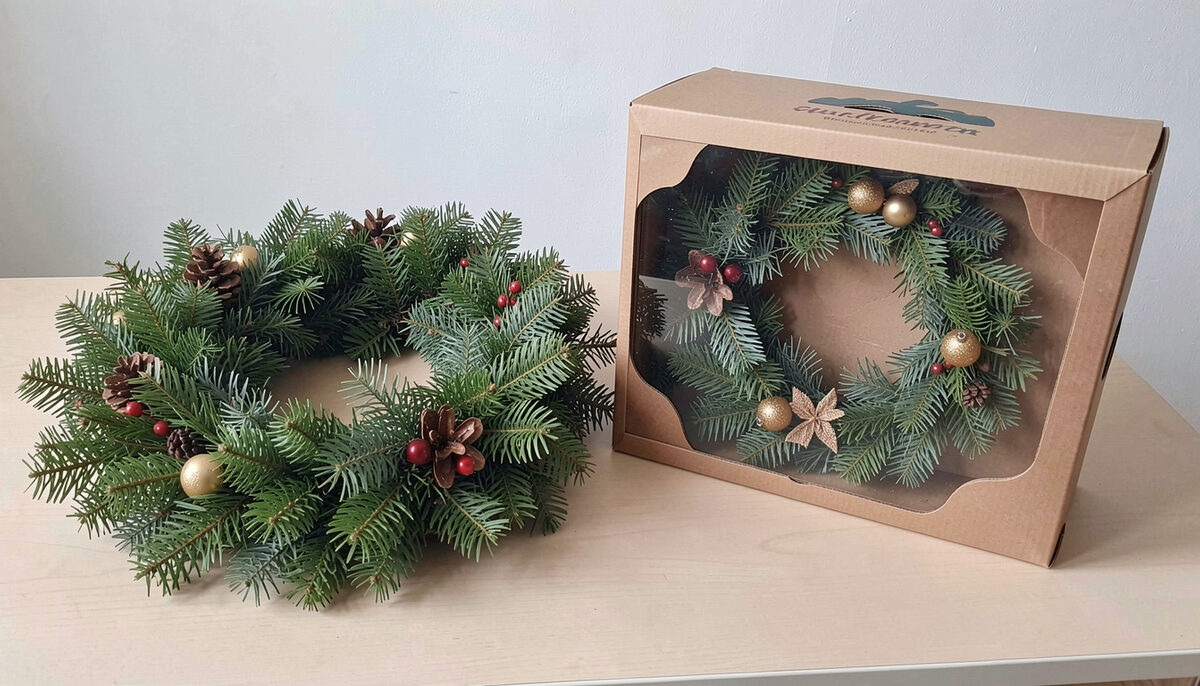
The fresh and artificial wreath markets sit side by side every December, and the choice between them is usually made on habit rather than on reasoning. Both products do the same job, which is to dress a door for winter. They differ in what they give the buyer, what they cost over time, and what has to be done with them when the season ends. This guide sets the two against each other on the points that actually change the decision.
Look and scent
A fresh wreath is alive when it arrives. The needles carry a blue green colour that varies naturally across the surface, and the wreath gives off the resin smell of cut evergreen for days or weeks. Nothing artificial reproduces that scent, and the colour of a plastic wreath tends to be uniform in a way that real foliage never is.
That said, artificial wreaths have improved a great deal. Good ones copy the shape and the colour of specific species closely, and at a distance on a door they are convincing. Up close, the difference shows in the texture of the needles, which are moulded rather than grown, and in the absence of any smell. The question is whether anyone will be close enough for that to matter, which is why the answer differs for a front door and for a garage.
Cost over time
A fresh wreath is bought again every year. An artificial wreath is bought once and stored. That single difference decides the economics. Over one season the fresh wreath is usually the cheaper purchase. Over five seasons the artificial wreath usually wins on total spend, unless the fresh wreaths were cheap and short lived and the artificial one was expensive.
The comparison is not exact, because the two products are not the same experience. A household that wants a real wreath on the door each year is buying the scent and the seasonal ritual, not a durable object. A household that wants a wreath that can be hung the day after Thanksgiving without a trip to a stall is buying convenience. Both are legitimate reasons to choose, and neither is a mistake.
Storage and reuse
An artificial wreath has to be stored carefully or it arrives next year crushed and dusty. A box that holds its shape, a dry place and a light dusting before it goes back on the door are enough for most. Stored badly, an artificial wreath can look worse than a fresh one within two seasons.
A fresh wreath has no storage question, because it is composted or turned into kindling at the end of the season. Many municipal recycling programmes accept fresh greenery after the holidays, and a fresh wreath can also be hung in a garden to shelter birds once it is dry. Nothing about a fresh wreath has to be kept.
Where each belongs
The strongest arrangement for most homes is a fresh wreath where people arrive and an artificial one where they do not. The front door is the place where scent, welcome and close up viewing all matter, which favours fresh. A side gate, a garage, a shed or a second door used by the family is a place where convenience matters more, which favours artificial.
Rented homes add a wrinkle. Where a door cannot be marked by a hanger, an artificial wreath is easier to fix with an adhesive hook, because it is light and does not need misting. A fresh wreath can still be used, but the fixing has to be chosen with care. The methods are set out in how to hang and care for a fresh wreath.
Care and lifespan of a fresh wreath
A fresh wreath needs nothing elaborate, but it does need attention. Kept out of direct heat and sun, misted occasionally, and hung where air moves, it can hold its colour for several weeks. Left above a heat vent or trapped between a door and a storm door in the sun, it can dry within days. The difference is entirely environmental.
The Christmas Tree Farmers Association of New York advises keeping a wreath out of the greenhouse effect between a door and a storm door, and notes that a wreath hung outdoors in a damp climate can last for months. That advice is a useful correction to the common assumption that indoors is always kinder to fresh greenery. It usually is not.
Making the choice
Choose fresh if you want scent, natural colour and the ritual of buying greenery each year, and if the wreath will hang where it can be seen closely. Choose artificial if you want a wreath that can go up early, come down late, and need nothing in between, or if the door is one where a fresh wreath would dry too fast.
If you decide on fresh, the checks that separate a good one from an old one are in how to choose a fresh wreath, and the bough comparison is in noble fir and mixed evergreen wreaths. The wider buying section is choosing, giving and caring for a wreath.
The middle ground: preserved greenery
Preserved greenery sits between the two. It is real foliage that has been treated so it keeps its colour and needs no care, which makes it a common choice for offices, hotel lobbies and homes that want the look of fresh without the upkeep. It has no scent and it is not alive, so it does not dry out and it does not revive. It also costs more than fresh, because of the extra process.
A preserved wreath is worth knowing about because it is often mistaken for a fresh one in a listing. If a wreath is described as needing no water and lasting for years, it is preserved rather than fresh. The distinction matters, because a buyer expecting the scent of fresh greenery will be disappointed by a product that has none.