Making and Materials
How a Fresh Evergreen Wreath Is Made
Follow how a fresh evergreen wreath is built, from bough selection and the wire frame to the bow, and what each step means for shape and freshness.
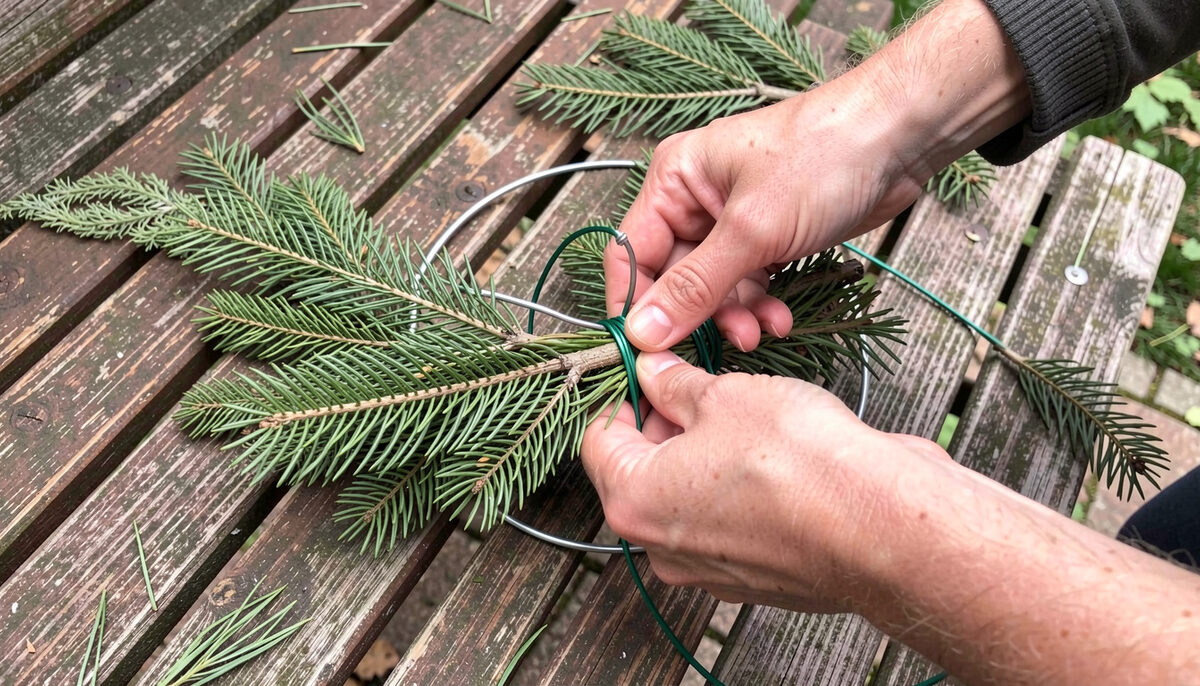
A fresh wreath is made in an hour or so at a bench, but the decisions behind it start months earlier in a field. The branch has to be the right species, cut at the right time, and handled so it still carries its needles when it reaches a door. The making itself is a short sequence: prepare the boughs, fix the frame, bind the bundles, shape the face, and finish the front. Each step is simple, and each step changes how the wreath looks and how long it lasts.
Why the branch matters more than the bow
A wreath is mostly branch. The bow and the cones sit on top of a structure that is ninety per cent greenery, so the quality of the branch sets the ceiling on everything else. A tired branch cannot be rescued by a good ribbon. A firm, well conditioned branch will still look full after the decoration has faded.
Two properties matter most. The first is how the branch holds its needles as it dries, because a wreath that sheds on the floor looks old quickly. The second is stiffness, because a limp branch will not hold the round shape of the ring. True firs such as noble fir are valued for both, which is why they dominate the fresh wreath trade in the Pacific Northwest.
Choosing and cutting boughs
Boughs are usually taken from trees grown for the purpose, and the cut happens when the tree is dormant and the needles have hardened for winter. Cutting too early, while the tree is still growing, gives soft growth that dries badly. Cutting in deep cold is hard on the worker but good for the product, because the branch is at its most stable.
At the bench, the maker sorts the boughs by length and by how they will sit on the ring. Long, straight tips go on the outer edge, where they define the circle. Shorter and denser pieces fill the middle. Anything brown, broken or bare is set aside. The sorting is the part visitors notice least and makers consider most, because a wreath is only as even as the pile it was built from. The OSU Extension guide to growing Christmas trees in the Pacific Northwest describes the species and the growing practices behind this supply in detail.
The frame
The frame is a ring, usually wire, sometimes a double wire ring, and occasionally a vine or wood base for a different look. Wire is the standard for fresh work because it is light, strong and cheap, and because the boughs can be tied to it at any point. The gauge of the wire matters more than buyers expect: a heavy wreath packed with wet greenery will pull a thin ring out of shape, especially if it hangs on a door that catches the wind.
A double ring gives the maker two rails to bind against, which produces a fuller face and a flatter back. A single ring is faster to work and lighter to ship. Neither is automatically better. The choice follows the size of the wreath and how it will be used. A large wreath for an exposed door wants a stiff frame. A small wreath for an indoor door can use a lighter one.
Bundling and wiring
Boughs are gathered into small bundles and bound to the ring with florist wire or twine. The maker lays a bundle along the ring, wraps the wire around both, and steps forward by roughly a hand span to lay the next bundle so it overlaps the first. Working in one direction around the ring produces the even, spiralled look of a well made wreath. Working carelessly produces gaps that show the wire and let the wreath look thin from the street.
Tension is the craft in this step. Bind too loosely and the boughs shift when the wreath is lifted. Bind too tightly and the wire cuts the branch, which shortens its life. Experienced makers work by feel, checking that a bundle holds firm when pulled but that the branch is not crushed. This is also the moment where a wreath is either generous or mean: the same ring can carry a thick, full face or a sparse one, and the difference is simply how many bundles the maker chooses to use.
Shaping the face
Once the ring is covered, the maker turns the wreath over and works the face. The aim is a flat, even circle with no obvious starting point and no hollow patches. Tips are teased outward to soften the edge, and any bundle that sits proud is tucked back. On a mixed wreath, the maker also decides where the cedar and the juniper sit so the texture is spread rather than bunched in one place.
Shaping is what makes two wreaths of the same diameter look different. A maker who takes time here produces a wreath that photographs well and hangs well. A maker who rushes leaves a wreath that reads as a ring of branches rather than as a finished piece.
The finish: bow, cones, berries and lights
The finish is the visible part. A bow is tied, usually from weather resistant ribbon for an outdoor wreath, and fixed at the top or offset to one side. Cones, berries and picks are wired in, and some wreaths carry a small battery light set. The finish is also where a wreath becomes a gift rather than a decoration, because a good bow and a neat tag are what a recipient sees first.
Decoration adds weight, so it belongs on a frame that can carry it. It also adds cost, and this is the honest reason two wreaths of the same size can differ sharply in price. More boughs, a stiffer frame, a wider ribbon, real cones rather than plastic ones and hand tying all take time or material. The section on choosing, giving and caring for a wreath explains how to read that difference as a buyer.
Checking the work before you hang it
A finished wreath can be checked in a minute. Hold it up and look for even coverage from the front and from an angle. Shake it gently and watch whether needles fall in any quantity. Squeeze a branch and feel whether it is pliable or already brittle. Look at the back and see whether the wire is tight and the frame is straight. Any of those checks failing tells you more about freshness than the price tag does.
If you are comparing bough mixes rather than makers, read noble fir and mixed evergreen wreaths next. If you want the shapes that share this same method but hang differently, see evergreen swags and garland.