Making and Materials
Evergreen Swags and Garland
See how evergreen swags and garland are made and measured, where each suits a door, rail or mantel, and how to keep fresh greens looking full.
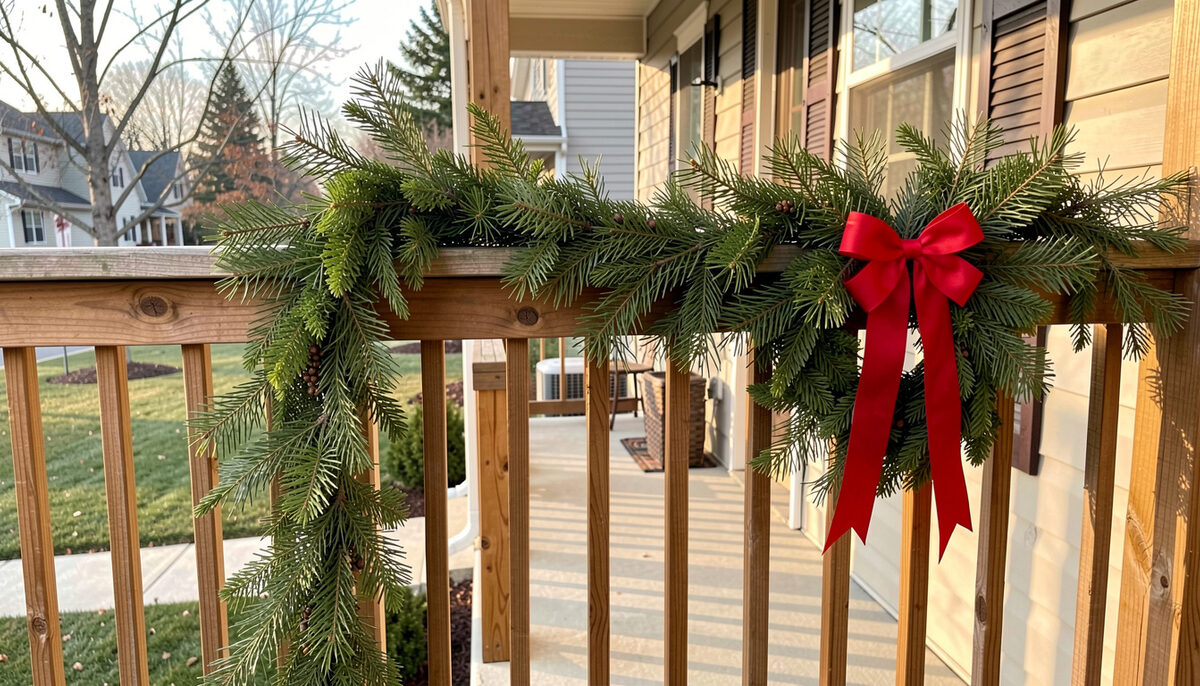
Not every piece of fresh greenery is a circle. A swag is a short length of boughs meant to hang vertically on a door, a post or a gate. Garland is a long rope of greenery meant to run along a rail, a mantel, a beam or an arch. Both use the same boughs and the same wire as a wreath, and both are measured differently, which is where most buyers go wrong.
What a swag is and where it belongs
A swag is a gathered bundle of evergreen, usually with a bow at the top and a taper toward the bottom. It is the piece for a narrow space: a front door beside a wreath, a lamp post, a mailbox, a fence post or a window frame. A swag reads as a vertical accent, so it suits places where a round wreath would look cramped or out of proportion.
Swags are measured by length rather than diameter. A common door swag runs from about two feet to three feet, and the taper means the widest part sits at the top. Because a swag is a single gathered piece rather than a ring, it is lighter than a wreath of similar span and easier to hang from a single hook. It also dries from the bottom up, so the top tends to look fresh longest.
What garland is and how it is sold
Garland is a continuous rope of greenery, made by binding bundles along a wire or cord in the same overlapping motion used for a wreath. It is sold by the foot, and the two numbers that matter are the length and the fullness. A garland can be thin, which is cheaper and suits a light rail, or thick, which carries more boughs per foot and suits a mantel or an arch where the greenery is seen close up.
Because garland is sold by length, buyers should measure the run and add a little. A rail that measures twelve feet needs a garland longer than twelve feet if it is to swag between fixing points rather than run straight. A mantel usually wants extra so the garland can drape at the ends. Getting this wrong is the most common garland mistake, and it cannot be fixed by adding a second piece, because the join shows.
How both are made
Swags and garland are made at the same bench as wreaths, from the same sorted boughs. The maker selects longer tips for the outer edge and shorter, denser pieces for the body, then binds in one direction so the overlaps run consistently. For garland, the bundles are laid along a running wire and spaced so the rope keeps an even thickness along its whole length.
The frame is simpler than a wreath ring. Garland needs only a running wire or cord strong enough to carry the weight when it is hung wet, and swags need a short stiff spine or a wire loop at the top. The making guide for wreaths, how a fresh evergreen wreath is made, describes the binding method that all three shapes share.
Choosing the boughs
The same species question applies. A garland or swag in pure noble fir is dense and formal, while a mix of fir, cedar and juniper is softer and more varied. Cedar is especially common in garland because its long, pliable branch drapes well and carries a strong scent, which is why cedar garland is a favourite for mantels and stair rails. The comparison in noble fir and mixed evergreen wreaths applies to these shapes as well.
Berries and cones are added the same way as on a wreath, wired in after the greenery is bound. On garland, decoration should be spaced evenly along the run, not bunched at one end, or the rope will look heavier in one place when it hangs.
Hanging and care
A swag hangs from a single point, so a nail, hook or over door hanger is enough. Garland is heavier and longer, so it usually needs several fixing points along the run, spaced so the rope does not sag between them. On a stair rail, fixings should follow the slope. On a mantel, they should sit where the garland will not rest against a heat source for long.
Care follows the same rules as for a wreath: keep the greenery out of direct heat and sun where possible, and mist it to slow drying. Garland hung above a working fireplace will dry faster than almost anything else in the house, because the rising heat pulls moisture out of the boughs. The routine in how to hang and care for a fresh wreath covers misting, shade and how to tell when a piece has dried out.
Buying for a group or a shop
Swags and garland are staples of fundraiser catalogues because they are easy to describe by length and easy to pack. A group selling greenery will usually offer a wreath, a swag and a garland together so that a supporter can decorate a whole porch from one order form. The trade side of that is covered in wreath fundraisers and wholesale. If you are choosing for a single door, the next useful read is how to choose a fresh wreath.
How much to order
A single door needs one wreath or one swag. A porch with two posts and a rail needs two swags and a length of garland long enough to run between them with a little slack. A mantel needs garland long enough to drape at both ends. A staircase needs garland measured along the slope, not along the floor beneath it.
Ordering slightly more than the measured run is the safer habit, because greenery cannot be stretched and a short garland leaves a bare gap. Leftover garland can be cut and used on a small rail or a window, so a little extra is rarely wasted. The mistake that cannot be fixed is ordering short.